


Her Vet Said the Food Was Enough. She Believed Her for 8 Months While Sophie Got Worse
She wasn't lying. She just didn't know. And nobody told Marilyn what shelters, breeders, and rescues have quietly been doing for decades.
Cat Whiskerer™ All Natural Cat Grass Chewing Sticks
🛡️ 60-Day Money-Back Guarantee
🌿 99.9% pure — pharmaceutical grade
📦 Orders Ship Within 24-48 hours
Almost Sold Out: High Demand Due To Our Limited Bundle Sale!
Couldn't load pickup availability
Specifications
Specifications
📦 Pack Count: 6 sticks per pack
🐱 Flavor: Irresistible chicken & fresh cat grass
🌿 Key Ingredients: 100% natural —fresh chicken, cat grass, salmon puree, fish oil, chicken liver, chicken heart, egg yolk powder
🧮 Serving Size: 1 stick in the morning, additional sticks as snacks (optional)
60-Day Money Back Guarantee
60-Day Money Back Guarantee
We want you and your cat(s) to be completely happy. That’s why all orders are covered by our 60-Day Money Back Guarantee. If you’re not satisfied, just reach out to us within 60 days of receiving your order and we’ll make things right.
Shipping & Delivery
Shipping & Delivery
We process orders within 24-48 hours.
Delivery typically takes 6-15 business days depending on your location.
Tracking shipment provided with every order.
Free shipping on multi-pack orders!

Cat Whiskerer™ All Natural Cat Grass Chewing Sticks


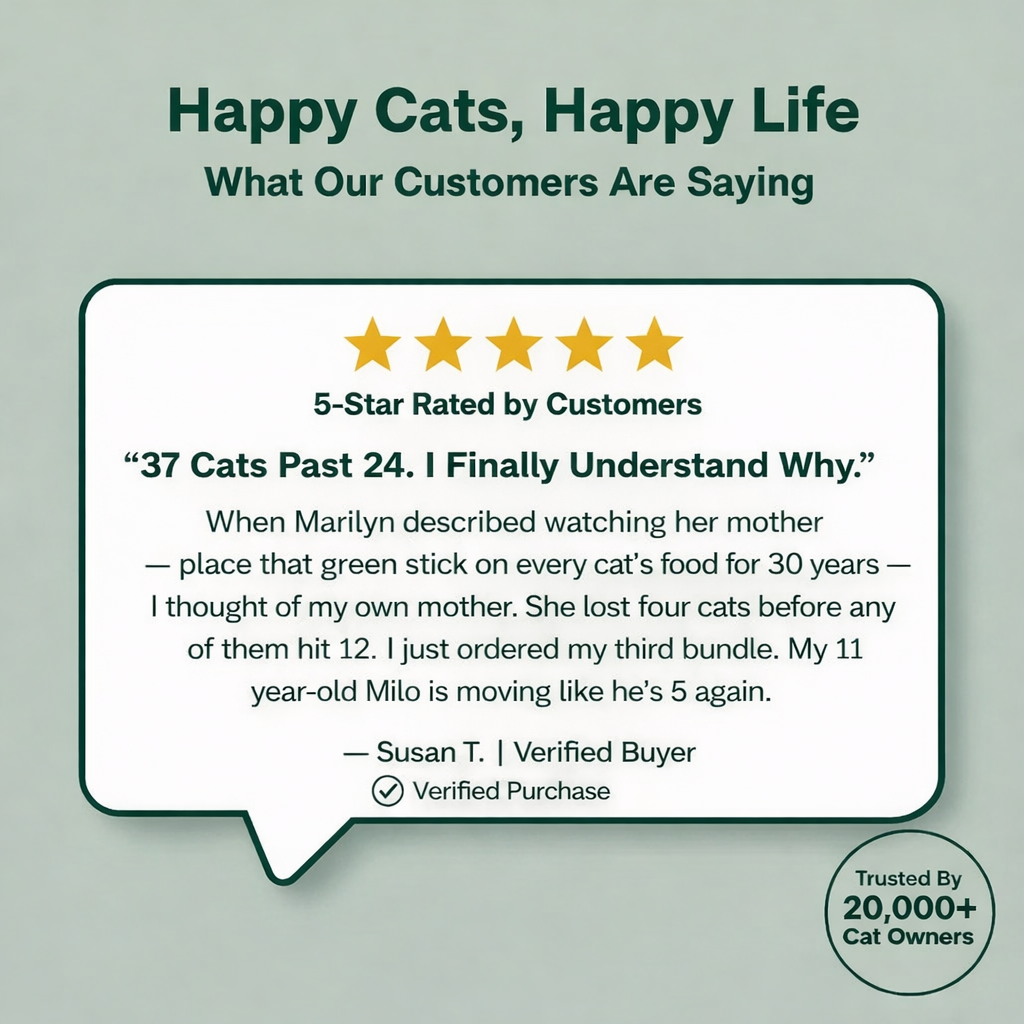
Marilyn waited 8 months. Here's what changed when she stopped
8
Months Marilyn waited for permission
7
Days before Sophie jumped on the couch again
3
Times her vet said "the food is enough"
0
Vets who ever mentioned daily fiber supplementation


Our Customers Are Noticing Results
-

2d ago
My vet said those exact words. "Her food is complete and balanced." I heard them at every checkup for three years while Cleo slowed down, stopped grooming, stopped jumping. The vet kept saying normal aging. I kept accepting it. I finally ordered without asking anyone's permission. That was six weeks ago. Cleo met me at the door this morning for the first time in eight months. I stood there and just stared at her.
812
58 Comments
LikeCommentShare -

12d ago
I'm a 67 year old man and I cried reading this. Not because of Sophie. Because of every cat I lost while my vet told me the food was enough. Oscar at 9. Mittens at 11. Beau at 10. Same speech every time. "These things happen." I have one cat left. She's 8. I ordered the same night I finished reading. I'm not waiting for permission from anyone.
1.2k
74 Comments
LikeCommentShare -

1d ago
What hit me was "your vet's job is to treat disease after it happens. Your job is to prevent it before it does." I've been outsourcing that job for twelve years. Three cats. None past 11. My vet always had an explanation. Normal aging. Bad luck. Genetics. I never questioned it. My current cat Pepper is 7. Started her the morning I finished reading. Two weeks in her coat is noticeably softer and she's back on the windowsill she abandoned months ago.
634
41 Comments
LikeCommentShare -

2d ago
I asked my vet about supplements at every visit for two years. Every time she redirected me to the prescription food on the shelf behind her. I bought it. Three different formulas. None of them changed anything. Mochi was still coughing every morning. Still sleeping sixteen hours a day. Still not jumping on the bed she used to own. My vet kept saying senior cats slow down. I kept nodding. Then I read about Marilyn sitting in her vet's office feeling stupid for asking a third time. That was me. That was exactly me. I ordered that night without telling my vet. Mochi is 13. She hasn't coughed in three weeks. She's back on the bed. I'm not going to tell my vet why either.
923
64 Comments
LikeCommentShare


Frequently Asked Questions
My vet says my cat's food is complete. Do they still need this?
My vet says my cat's food is complete. Do they still need this?
Marilyn heard those exact words three times. Her vet wasn't lying — she just didn't know. Commercial food meets a legal minimum set in 1987, designed to prevent acute collapse. Not designed to keep a cat thriving past 15. Vets treat disease. They don't optimize for longevity. Shelters, breeders, and rescues figured this out decades ago. Your vet's job is to treat disease after it happens. Your job is to prevent it before it does.
My cat seems perfectly healthy right now. Do I really need to start this?
My cat seems perfectly healthy right now. Do I really need to start this?
Sophie seemed fine too — until she didn't. The decline happened slowly. Eight months of small changes Marilyn almost explained away. Perfectly healthy is the best possible moment to start — because that's when you can still protect everything. The families whose cats made it past 20 started from day one. Not when something went wrong. Not when the vet got worried. From day one.
My cat is already 10 or 11. Is it too late?
My cat is already 10 or 11. Is it too late?
Two cats inherited at 19 and 17 were already declining after the ritual was forgotten for a few weeks. Within a month of restarting, one was jumping on the bed again. The other's coat came back soft and shiny. Both are still going — at 22 and 20. It's never too late to restore what's been depleted. The 60-day guarantee means you risk nothing finding out.
I've tried cat grass before and my cat wouldn't eat it.
I've tried cat grass before and my cat wouldn't eat it.
Many cat owners panic when their usual supplier closes and try pet store versions — garbage, full of fillers. Amazon brands — half of them do nothing. The difference is pharmaceutical-grade purity. 99.9% pure, no synthetic additives, no smell. Cats don't even notice it's there. If yours rejected something before, it almost certainly wasn't this quality.
Is this the same quality that shelters and breeders use?
Is this the same quality that shelters and breeders use?
Yes — 99.9% pharmaceutical-grade, no fillers, no synthetic additives. The same standard the families with 20-year-old cats maintained for 50 years. The same standard shelters and breeders have known about for decades. Families who switched to grocery store brands lost five cats in the time families who supplemented consistently lost two. Quality isn't a minor variable. It's the entire difference.
What if my cat is picky?
What if my cat is picky?
The sticks are made with real chicken, salmon puree and fish oil. Most cats eat them without noticing they're there — as part of their food rather than something separate. If yours is resistant, try placing the stick on wet food for the first few days. And if after 60 days it's genuinely not working, the guarantee covers you completely.
My vet calls my senior cat's decline "just old age." Should I be worried?
My vet calls my senior cat's decline "just old age." Should I be worried?
That's what vets said about cats that were already declining after just a few weeks without the daily routine. "Just getting old." The owners almost accepted it. Then they restarted the packet. Within weeks both cats reversed course. Vets have called the longevity of cats in these families "remarkable genetics" for decades without ever asking what they were doing differently. Vets treat disease. They don't optimize for longevity. Now you know what those families knew.
Why has nobody told me about this before?
Why has nobody told me about this before?
The families who knew watched the habit happen every morning for 30 years without questioning it. It was just part of the day. It fell outside standard clinical nutrition guidelines so vets never mentioned it. It wasn't prominently stocked in pet stores so nobody stumbled across it. It was passed down quietly through families who assumed everyone else was doing the same thing. They weren't. Breeders know. Shelters know. The families with 20-year-old cats know. Now you do too.
"You don't need your vet's permission. You just need to start."